Shop By Category
Take 20% OFF Your Order* - Ends Wednesday

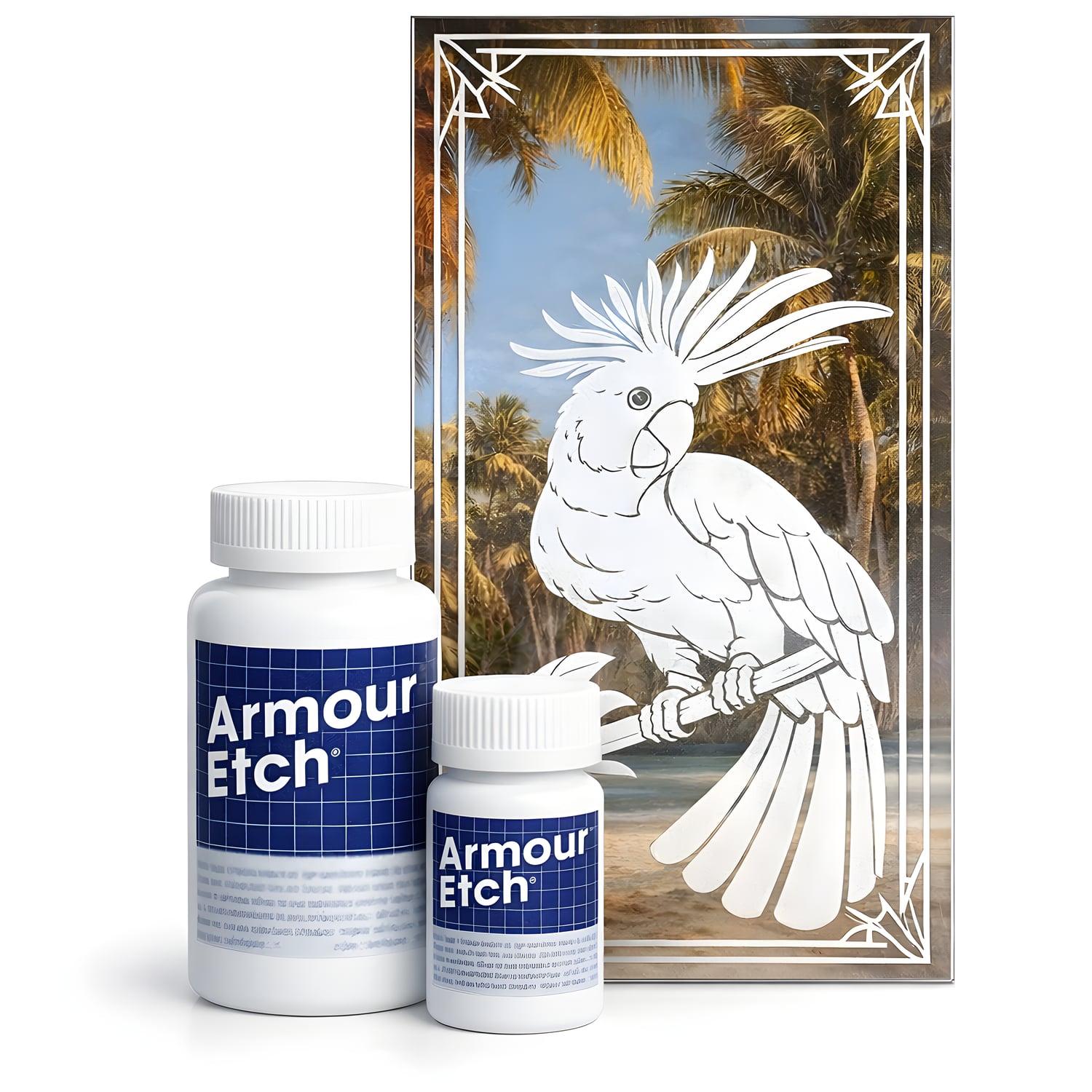
Armour Etch Cream - 3 Oz

Armour Etch Cream - 3 Oz
$14.95 USD
Item# 5530   In Stock

Product Features

  • Etch designs into your glass in just 3 steps! See below
  • Paste works well on all glass, especially dichroic and iridized art glass
  • Simple 5 minute process
  • Sold in a 3 oz bottle


Product Description

Easily Add Detail
Etching is a great technique for creating beautiful designs on glass. Just apply a stencil, brush on etching cream, let it stand a few minutes, and wash off. Etched designs on mirrors look especially decorative and are very popular. Or try etching on dichroic glass to add perfect detail to jewelry. See step-by-step below. Note: always wear rubber gloves when using etching cream. Will not etch plastic and some Pyrex.

Delphi Tips:

  • Ideal for removing the coating of dichroic glass or iridized glass.
  • This method is best on clear glass. It will eat into the surface of the glass, however this technique is more subtle than actual sandblasting.

Project created by Delphi Artist Julie Haan using a 4" Mirror Bevel #5240MIR and box #10372. Snowflake project created by artist Kayleigh Clark.
 
Step-By-Step: Bottle Votive Holder
Step A
Step B

 
1. Place self sticking stencil on glass.

2. Apply etching cream.
Step C
Step D

 
3. Wait 5 minutes and rinse.

4. Mark your place then repeat steps 1 through 3.

 
California Prop 65 WARNING: This product can expose you to chemicals including lead, which are known to the State of California to cause cancer and birth defects or other reproductive harm. For more information go to www.P65Warnings.ca.gov
This item cannot be shipped air.

Customers Who Viewed This Item Also Viewed

Customer Reviews

5 out of 5 stars
5 star  
  4
4 star
  0
3 star
  0
2 star
  0
1 star
  0
See all 4 customer reviews
Write a customer review

Product Images from Customers

Be the first to share product images with other customers
5 out of 5 stars
  •  
By on
Pros :
Cons :
Was this review helpful to you?  
2 of 7 people found this review helpful
5 out of 5 stars
  •   It works
By on
Pros : Works to remove dichroic film. Need to wait 5 minutes.
Cons :
Was this review helpful to you?  
2 of 5 people found this review helpful
5 out of 5 stars
  •   Good & Easy
By on
Pros : I use this all the time in my jewelry designing with dichroic glass. It gives great results. Easy to use and is very quick. You are only limited to your imagination. It doesn't take much so it lasts a long time (in jewelry anyway.)
Cons : Not any really. Just leave on at least minimal amount of time.
Other Thoughts : Use with or without stencils for fine details.
Was this review helpful to you?  
2 of 4 people found this review helpful

See all 4 customer reviews
Related Content
My commuting jacket is drying over a kitchen chair, and the cat has come down off the workbench to sniff the sleeve with deep suspicion. Fair enough. Theres a stripe of brown grit up the back, the kind wet roads and mashed leaves throw up all autumn.That grit ends up on brakes too. So heres a short pre-winter check for Defiant riders. Im working from general technique and the JupiterBike product listings, not from my own bike.Why autumn chews through brake padsQuick jargon check. On a disc brake, a metal disc called the rotor is fixed to the wheel hub. Two pads squeeze it to slow you down. They sit in a caliper, the clamp that straddles the rotor.Wet roads carry grit and leaf mush onto the rotor. When you brake, that grit gets trapped between pad and rotor and works like sandpaper, so the same commute wears pads faster