Shop By Category
25% OFF Any 1 Item* - Ends Monday

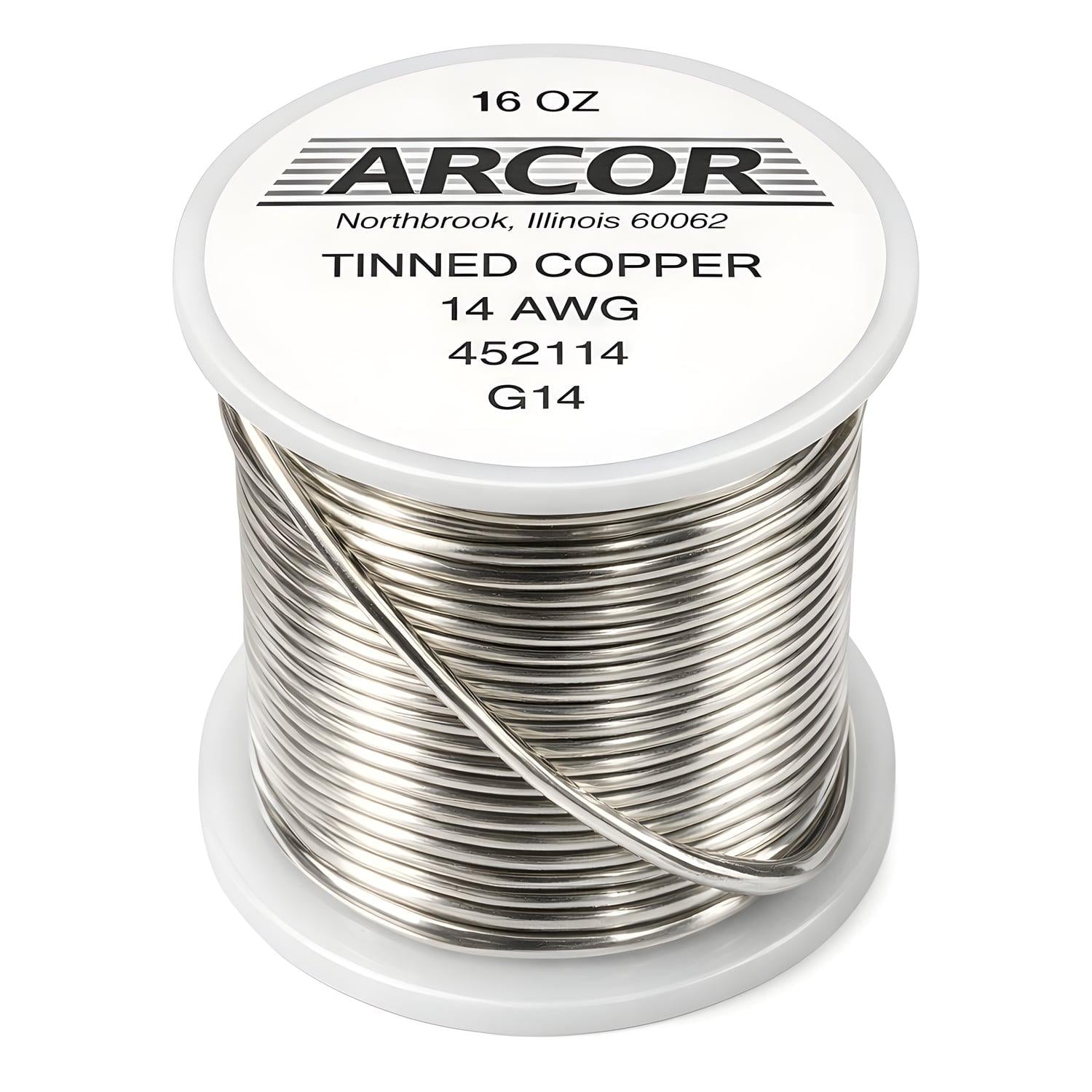
14 Gauge Pre-Tinned Wire - 1 Lb

14 Gauge Pre-Tinned Wire - 1 Lb
$51.95 USD
Item# 452114   In Stock

Product Features

  • Pre-tinned wire has many uses in stained glass, jewelry and soldering projects
  • 14 gauge wire sold in a 1 lb spool


Product Description

The tin layer on tinned wire protects the copper core from oxidizing and accepts solder with minimal cleaning. Silver colored and will accept patina. Use as reinforcement in suncatchers, to make jump rings and for applying quick and easy decoration to your soldering. Sold in 1 pound spools.

14 gauge wire is thin enough to use as a decorative element but strong enough to use in hanging.  14 ga measures 1/16" in diameter.

Hummingbird Feeder project by artists Melanie Poddig and Kayleigh Clark. Pumpkin suncatcher by artist Nancy Wiswell. From Delphi's Online Artist Gallery.

Customer Reviews

4.8 out of 5 stars
5 star  
  4
4 star
  1
3 star
  0
2 star
  0
1 star
  0
See all 5 customer reviews
Write a customer review

Product Images from Customers

Be the first to share product images with other customers
5 out of 5 stars
  •   good
By on
Pros : use it all the time, useful to have.
Cons :
Was this review helpful to you?  
1 of 2 people found this review helpful
5 out of 5 stars
  •   Only ARCO
By on
Pros : I only use ARCO wire for my work. It is by far the easiest to use. It is well tinned and keeps shiny after polishing. I use all the gauges from 14g thickest to 22g the thinnest.
Cons : No cons
Other Thoughts : I suggest buying 16 to start if you only want to buy one to try it. It can be used for most any application and can also be twisted if you need stronger wire. 14 g is good to use for hangers and 18 - 22 are best for trim. Use 24g only if you want very thin wire. (I have them all)
Was this review helpful to you?  
10 of 13 people found this review helpful
4 out of 5 stars
  •   Heavy wire
By on
Pros : This is the first time I saw this gauge wire in your catalog.. Have to try it. Twist two pieces together to use as a boarder for a smaller panel.
Cons :
Other Thoughts : Should work great
Was this review helpful to you?  
3 of 6 people found this review helpful

See all 5 customer reviews
Related Content
How and when did you get started in glass art? I saw an article about Kristin Frantzen-Orr along with a step by step example of how to do one of her famous floral beads. I talked about it so much my husband bought me a beginning torch set for the following Christmas. Once I got the kiln and the duel fuel torch, I just kept experimenting and growing from there. Kristin is still my idol and I keep telling myself that one day I will do nice, clean floral beads like hers. Your jewelry, vases, plates etc. are all beautiful. I especially love the geologic nature of your Copper Reactive dish, its so unique. Can you tell us a little about how you achieved that look? The base glass is Bullseye Steel Blue Opal (000146) and it reacts all on its own. I used clear stringers and broke up chunks
We tell ourselves not to judge a book by its cover, but the simple truth is, we are attracted to whats attractive. On a recent hunt for a birthday present for my mother, I came across several beautiful handbags in several different boutiques. What ultimately influenced my final purchase decision was the complimentary gift-wrapping offered by one of the storeowners. The handbag itself wasnt any prettier or better quality than the others I was considering, but the packaging was beautiful. Brightly colored tissue, a big sturdy box, quality wrapping paper and an oversized hand-tied bow. No, it wasnt sealed with a kiss, rather a large gold embossed sticker with the boutique name and logo (theres nothing wrong with a little discreet self-promotion). Here are a few tips for better packaging-it might just buy you your next customer. 1. Show your customers what theyll get. The boutique I mentioned earlier had
Delphi merchandiser Kayleigh McGrath recently shared some photos from her early days at Delphi. She was playing around with different colors and textures of glass and learning the hard way that there are limits to what you can do (and cant do) in fusing. The first image shows what happened when Kayleigh layered dichroic glass, coating to coating. The base is 90 COE dichroic rainbow pixi stix on black, (Delphi item 921714) and the top is an old texture we dont carry any more (cyan red radium on clear.) The second image is of a piece Kayleigh loved so much she impatiently removed it from the kiln when it was still too hot (havent we all done this. ) As you can see, it suffered thermal shock. This was made with the same 90 COE pixi stix on black for the base and capped with Delphi item U630090 90 COE