Shop By Category
Take 20% OFF Your Order* - Ends Today

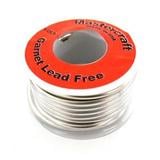
Mastercraft Lead-Free Solder - 1/4 Lb

Mastercraft Lead-Free Solder - 1/4 Lb by Mastercraft
Price $14.95
Your Savings: - $7.95
Your Price: $7.00 USD   (54% Off)
We're sorry, discount coupons do not apply to this item.
Item# 2996   In Stock

Product Features

  • Lead-Free - Ideal to use when making jewelry or anything that will be in contact with skin
  • Convenient 1/4 lb spool
  • Updated formula for improved ease of flow and a shinier finish


Product Description

Lead-free solder is a wonderful solution for stained glass items that will be handled often. It's particularly good for kaleidoscopes, three dimensional projects and jewelry. Lead-free solder has a higher melting temperature, which may require a higher temperature tip or rheostat, depending on your iron. A separate soldering iron tip is recommended to keep your project lead free. Sold in 1/4 pound spools.

Improved formula allows for easier flow when soldering. Also provides a better shine when polished.

Delphi Tip: Lead-Free Solder should be used when making projects where your skin comes in contact with it, such as jewelry, boxes and kaleidoscopes.

Soldered jewelry shown made by artist Shannon Jones. Group image of soldered jewelry from "Simply Soldered" book #6648.

Supplies are limited. Order early for best selection. All sales of clearance items are final.

Customer Reviews

4.5 out of 5 stars
5 star  
  1
4 star
  1
3 star
  0
2 star
  0
1 star
  0
See all customer reviews
Write a customer review

Product Images from Customers

Be the first to share product images with other customers
4 out of 5 stars
  •   Lead free
By on
Pros : Nice to be lead free for jewelry
Cons : Needs a gel flux and controllable heat, LOW shine looks like aluminum instead of silver.
Was this review helpful to you?  
8 of 10 people found this review helpful
5 out of 5 stars
  •   DSG Lead free solder review
By on
Pros : Easy to use, superior control of decorative solder, better after shine on silver, does not easily tarnish (unlike lead - can leave it covered in flux and in a humid workshop for days w/o change- can then pick right up and finish decorative solder, takes copper patina as if I were soldering with pure copper. Lead free.
Cons : Would love to see the price come down and the availability go up.
Was this review helpful to you?  
9 of 11 people found this review helpful

See all customer reviews
Related Content
My commuting jacket is drying over a kitchen chair, and the cat has come down off the workbench to sniff the sleeve with deep suspicion. Fair enough. Theres a stripe of brown grit up the back, the kind wet roads and mashed leaves throw up all autumn.That grit ends up on brakes too. So heres a short pre-winter check for Defiant riders. Im working from general technique and the JupiterBike product listings, not from my own bike.Why autumn chews through brake padsQuick jargon check. On a disc brake, a metal disc called the rotor is fixed to the wheel hub. Two pads squeeze it to slow you down. They sit in a caliper, the clamp that straddles the rotor.Wet roads carry grit and leaf mush onto the rotor. When you brake, that grit gets trapped between pad and rotor and works like sandpaper, so the same commute wears pads faster

4 Stars and Above

You may also like

item: SBR308
item: SBR400
item: SBRCIN
item: X100SN
Oceanside Clear Satin
Starting at $6.85
item: X100C
Oceanside Clear Cord
Starting at $6.85
item: X100K
Oceanside Clear Krinkle
Starting at $6.85
item: X100HS
Oceanside Clear Small Hammered
Starting at $6.85
item: X100GG
Oceanside Clear Crystal Ice
Starting at $6.85